2014年1月14日 星期二

Groups

The Groups envisaged here are very different. Their members would share a new philosophy, a philosophy of the love of life, its manifestations in human relations, politics, art, social organization. What would be characteristic of them is that none of these areas of human activities is isolated from each other, but each aspect gets its meaning by being related to all others.

…They should become a real home for every participant, a home where he finds nourishment in the sense of knowledge and of interpersonal sharing and, at the same time, where he has a chance to give. Their aim would be to move toward a personal transformation from an alienated person into one of active participation. Naturally, the Groups would be critical of the conduct of life as the alienated society offers it, but they would try to find an optimum of personal non-alienation rather than the solace of constant indignation as a substitute for being alive.

The Groups would develop a new style of life, unsentimental, realistic, honest, courageous, and active. It must be stressed that realistic unsentimentality – bordering, if you like, on cynicism – needs to be united with deep faith and hope. Usually the two are disconnected. People of faith and hope are often unrealistic, and the realists have little faith or hope. We shall find a way out of the present situation only if realism and faith become blended again as they were in some of the great teachers of mankind.


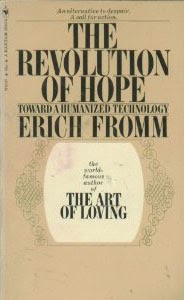
excerpt from: Erich Fromm (1968) The Revolution of Hope.
more: Groups pdf
2014年1月7日 星期二

國際協作動力讀書會(18 Jan 2014)

Collaborative Initiatives International organizes reading circle on monthly basis. All are welcome.  
國際協作動力每月舉行讀書會,歡迎各界人仕參加。

活動內容       :   文章分享 Sharing of reading materials; 
                           協作訓練 - 溝通 | 協作領導 | 社群建立                         
                           Exercises for communications, collaborative leadership and community building;                                 集思活動 Brainstorming Activities
                             
Place 地點     :  Club House, 8 Waterloo Road, Yau Ma Tei (油麻地窩打老道8號會所)
Date日期       :  (every third Sat evening), coming: 18 Jan 2013 (每月第三個星期六)
Time時間       :  7:30 – 9:30 pm
Contact聯絡  :  Desmond Chan 9033 4604, ytchan.hkg@gmail.com
Reading Materials 閱讀資料 : (1-3月) 葛琳卡《情緒四重奏》。

(報名請留下聯絡電話及姓名,聚會時間地點如有更改當另行通知。Please leave your name and mobile number for contact. Separate notice shall be given should there be any changes on gathering location and time.)

2014年1月3日 星期五

Greed

Greed is a common quality of desires by which men are driven to achieve a certain goal. In the nongreedy feeling, man is not driven, he is not passive, but he is free and active.

Greed can be motivated in two ways: 1. By a physiological imbalance which produces the greedy desire for food, drink, etc. Once the physiological need is satisfied, the greed ceases, unless the imbalance is chronic. 2. By a psychological imbalance, especially the presence of increased anxiety, loneliness, insecurity, lack of identity, etc., which is alleviated by the satisfaction, power, fame, property, etc. This type of greed is, in principle, insatiable, unless a person’s anxiety, etc., ceases or is greatly reduced. The first type of greed is reactive to circumstances; the second is inherent in the character structure.

The greedy feeling is highly egocentric. Whether it is hunger, thirst, or sexual desire, the greedy person wants something for himself exclusively, and that by which he satisfies his desire is only a means for his own purposes. This is obvious when we speak of hunger and thirst, but it is also the case when we speak of sexual arousal in its greedy form, where the other person becomes primarily an object. In the non-greedy feeling, there is little egocentricity. The experience is not needed to preserve one’s life, to allay anxiety, or to satisfy or enhance one’s ego; it does not serve to still a powerful tension, but begins precisely where necessity in the sense of survival or stilling of anxiety ends. In the non-greedy feeling, the person can let go of himself, is not compulsively holding on to what he has and what he wants to have, but is open and responsive.


excerpt from: Erich Fromm (1968) The Revolution of Hope.
pdf: Greed

2013年12月29日 星期日

Fortitude

Fortitude is the capacity to resist the temptation to compromise hope and faith by transforming them – and thus destroying them – into empty optimism or into irrational faith. Fortitude is the capacity to say “no” when the world wants to hear “yes.”

… The third kind of fearlessness is to be found in the fully developed person, who rests within himself and loves life. The person who has overcome greed does not cling to any idol or any thing and hence has nothing to lose; he is rich because he is empty, he is strong because he is not the slave of his desires. He can let go of idols, irrational desires, and fantasies, because he is in full touch with reality, inside and outside himself. If such a person has reached full “enlightenment,” he is completely fearless. If he has moved toward his goal without having arrived, his fearlessness will also not be complete. But anyone who tries to move toward the state of being fully himself knows that whenever a new step toward fearlessness is made, a sense of strength and joy is awakened that is unmistakable. He feels as if a new phase of life had begun. He can feel the truth of Goethe’s lines: “I have put my house on nothing, that’s why the whole world is mine.” (Ich hab mein Haus auf nichts gestellt, deshalb gehört mir die ganze Welt.)

Hope and faith, being essential qualities of life, are by their very nature moving in the direction of transcending the status quo, individually and socially. It is one of the qualities of all life that it is in a constant process of change and never remains the same at any given moment. Life that stagnates tends to die; if the stagnation is complete, death has occurred. It follows that life in its moving quality tends to break out of and to overcome the status quo. We grow either stronger or weaker, wiser or more foolish, more courageous or more cowardly. Every second is a moment of decision, for the better or the worse. We feed our sloth, greed, or hate, or we starve it. The more we feed it, the stronger it grows; the more we starve it, the weaker it becomes.

What holds true for the individual holds true for a society. It is never static; if it does not grow, it decays; if it does not transcend the status quo for the better; it changes for the worse. Often we, the individual or the people who make up a society, have the illusion we could stand still and not alter the given situation in the one or the other direction. This is one of the most dangerous illusions. The moment we stand still, we begin to decay.


excerpt from: Erich Fromm (1968) The Revolution of Hope.
pdf: Fortitude

2013年12月27日 星期五

Faith

Faith is not a weak form of belief or knowledge; it is not faith in this or that; faith is the conviction about the not yet proven, the knowledge of the real possibility, the awareness of pregnancy. Faith is rational when it refers to the knowledge of the real yet unborn; it is based on the faculty of knowledge and comprehension, which penetrates the surface and sees the kernel. Faith, like hope, is not prediction of the future; it is the vision of the present in a state of pregnancy.

The statement that faith is certainty needs a qualification. It is certainty about the reality of the possibility – but it is not certainty in the sense of unquestionable predictability. The child may be stillborn prematurely; it may die in the act of birth; it may die in the first two weeks of life. That is the paradox of faith: it is the certainty of the uncertain. It is certainty in terms of man’s vision and comprehension; it is not certainty in terms of the final outcome of reality. We need no faith in that which is scientifically predictable, nor can there be faith in that which is impossible. Faith is based on our experience of living, of transforming ourselves. Faith that others can change is the outcome of the experience that I can change.

There is an important distinction between rational and irrational faith. While rational faith is the result of one’s own inner activeness in thought or feeling, irrational faith is submission to something given, which one accepts as true regardless of whether it is or not. The essential element of all irrational faith is its passive character, be its object an idol, a leader, or an ideology. Even the scientist needs to be free from irrational faith in traditional ideas in order to have rational faith in the power of his creative thought. Once his discovery is “proved,” he needs no more faith, except in the next step he is contemplating. In the sphere of human relations, “having faith” in another person means to be certain of his core – that is, of the reliability and unchangeability of his fundamental attitudes. In the same sense we can have faith in ourselves – not in the constancy of our opinions but in our basic orientation to life, the matrix of our character structure. Such faith is conditioned by the experience of self, by our capacity to say “I” legitimately, by the sense of our identity.

Hope is the mood that accompanies faith. Faith could not be sustained without the mood of hope. Hope can have no base except in faith.


excerpt from: Erich Fromm (1968) The Revolution of Hope.
pdf : Faith

2013年12月22日 星期日

Compassion and Empathy

Compassion and empathy are two other feelings clearly related to tenderness but not entirely identical with it. The essence of compassion is that one “suffer with” or, in a broader sense, “feels with” another person. This means that one does not look at the person from the outside – the person being the “object” of my interest or concern – but that one puts himself into the other person. This means I experience within myself what he experiences. This is a relatedness which is not from the “I” to the “thou” but one which is characterized by the phrase: I am thou. Compassion or empathy implies that I experience in myself that which is experienced by the other person and hence that in this experience he and I are one. All knowledge of another person is real knowledge only if it is based on my experiencing in myself that which he experiences. If this is not the case and the person remains an object, I may know a lot about him but I do not know him. Goethe has expressed this kind of knowledge very succinctly: “Man knows himself only within himself, and he is aware of himself within the world. Each new object truly recognized opens up a new organ within ourselves.”

The possibility of this kind of knowledge based on overcoming the split between the observing subject and the observed object requires, of course, the humanistic promise which I mentioned above, namely, that every person carries within himself all of humanity; that within ourselves we are saints and criminals, although in varying degrees, and hence that there is nothing in another person we cannot feel as part of ourselves. This experience requires that we free ourselves from the narrowness of being related only to those familiar to us, either by the fact that they are blood relations or, in a larger sense, that we eat the same food, speak the same language, and have the same “common sense.”


excerpt from: Erich Fromm (1968) The Revolution of Hope.
pdf: Compassion and Empathy

2013年12月16日 星期一

On Self Realization

Why is spontaneous activity the answer to the problem of freedom? We have said that negative freedom by itself makes the individual an isolated being, whose relationship to the world is distant and distrustful and whose self is weak and constantly threatened. Spontaneous activity is the one way in which man can overcome the terror of aloneness without sacrificing the integrity of his self; for in the spontaneous realization of the self man unites himself anew with the world - with man, nature, and himself.

Love is the foremost component of such spontaneity; not love as the dissolution of the self in another person, not love as the possession of another person, but love as spontaneous affirmation of others, as the union of the individual with others on the basis of the preservation of the individual self. The dynamic quality of love lies in this very polarity; that it springs from the need of overcoming separateness, that it leads to oneness - and yet that individuality is not eliminated.

Work is the other component; not work as a compulsive activity in order to escape aloneness, not work as a relationship to nature which is partly one of dominating her, partly one of worship of and enslavement by the very products of man's hands, but work as creation in which man becomes one with nature in the act of creation. What holds true of love and work holds true of all spontaneous action, whether it be the realization of sensuous pleasure or participation in the political life of the community. It affirms the individuality of the self and at the same time it unites the self with man and nature. The basic dichotomy that is inherent in freedom - is dissolved on a higher plane by man's spontaneous action.

In all spontaneous activity the individual embraces the world. Not only does his individual self remain intact; it becomes stronger and more solidified. For the self is as strong as it is active. There is no genuine strength in possession as such, neither of material property nor of mental qualities like emotions or thoughts. There is also no strength in use and manipulation of objects; what we use is not ours simply because we use it. Ours is only that to which we are genuinely related by our creative activity, be it a person or an inanimate object. Only those qualities that result from our spontaneous activity give strength to the self and thereby form the basis of its integrity.

The inability to act spontaneously, to express what one genuinely feels and thinks, and the resulting necessity to present a pseudo self to others and oneself, are the root of the feeling of inferiority and weakness. Whether or not we are awear of it, there is nothing of which we are more ashamed than of not being ourselves, and there is nothing that gives us greater pride and happiness than to think, to feel, and to say what is ours.

excerpt from: Erich Fromm (1941) Escape from Freedom.
more: On Self Realization